
Box Gutter Repair in Minneapolis, Minnesota (MN)
The older rooflines of Minneapolis drain through troughs nobody can see. Our crew surveys them, names the failure and prices the fix in writing, anywhere in Hennepin County.
The call costs nothing and commits you to nothing. Any call-out fee for the survey is named when the date is set, and the written report follows the survey.
- Population
- 416,021
- County
- Hennepin County
- State
- Minnesota
- Region
- Midwest
- Median income
- $58,993
Restoring your hidden roof drainage systems in Minneapolis
Fixing those internal metal troughs tucked behind your roofline stops water from rotting your wood framing and saves you from expensive structural damage. These integrated channels often collect debris and cause overflow, which makes routine maintenance essential to keep your home dry and safe during heavy storms. Getting a free quote from a pro in Hennepin County helps you address these tricky leaks before they lead to serious interior wall issues.
Why these built-in systems need extra attention
These recessed metal vessels carry water away from your siding through channels hidden directly inside the structure. Because they sit flush with your roof eaves, they often trap leaves and ice dams that create persistent moisture buildup. This constant dampness creates a breeding ground for rust and rot, which means you should prioritize inspecting them before every winter season.
Checking the lining for cracks or failing soldered joints lets you catch small problems before they turn into major headaches. A skilled trade person will examine the drainage slope to ensure water flows away from your shingles without pooling. That inspection prevents the dreaded overflow that ruins your paint and siding, giving you total peace of mind throughout the wet months.
Addressing common issues in the city
Living in this northern climate means your home faces extreme temperature swings that stress every inch of your exterior building components. Frozen runoff often expands inside these tight spaces, which can force seams apart and create gaps that leak directly into your attic or walls. Identifying these spots early stops the cycle of damage and helps you maintain a solid barrier against the elements.
Sometimes the problem stems from debris blocking the primary flow point, which forces water to back up into the structure. Removing this blockage restores proper function and keeps your building envelope intact while preventing long-term decay. You should always ask your chosen contractor if they carry proper insurance to cover the heights and specific risks involved in this delicate work.
How to identify a failing system
Water stains on your ceilings often appear far away from the actual source of the leak because these channels travel horizontally behind your fascia. If you notice damp spots near your eaves, the issue is likely a failure in the internal membrane of your drainage hardware. Addressing this right away keeps your house foundation dry and prevents the growth of mold in your crawl spaces.
| Common Symptom | Potential Consequence |
| Peeling exterior paint | Wood rot underneath |
| Interior ceiling stains | Damaged insulation and drywall |
| Pooling near the roof | Structural weakening over time |
Selecting the right local help
Finding a qualified worker in the area requires checking for a valid license and a commitment to high quality standards. You want someone who understands the specific codes required for historic or modern homes in 55401 and nearby neighborhoods. Asking for a detailed breakdown of the proposed repair ensures you know exactly how the metal will be sealed or replaced.
This professional approach creates a lasting sense of tranquility for your household because you know the work is handled correctly. A good pro will explain if they plan to reline the channel or perform a complete rebuild of the metal structure. Once you have a clear plan, you can rest easy knowing your home is shielded from the next heavy rainfall or thaw.
Taking the next step for your home
Getting a free quote for your project is the smartest way to compare options and understand the true cost of your specific repairs. You deserve a solution that fits your budget while providing the necessary resilience against our local weather patterns. Simply describe your current roof situation and what you need fixed to get started on protecting your most valuable asset today.
This process is straightforward and connects you with folks who know exactly how to manage these integrated, hidden water management devices. By acting now, you prevent the costs associated with major wood replacement or interior mold remediation that often follows ignored leaks. Take control of your property upkeep by requesting your no-obligation estimate from a pro serving Minneapolis and the surrounding region.
Key benefits of proactive maintenance
Taking care of these features provides longevity for your roof assembly by stopping water where it wants to intrude. You avoid the high price of emergency repairs that often arise when a small leak turns into a structural emergency. Choosing to patch or replace these parts with durable shielding materials offers a high level of calm during every storm.
Regular checkups ensure your downspouts and internal seams remain clear of obstructions that impede drainage. This simple act of upkeep keeps your home exterior looking sharp while maintaining the integrity of your framing. You can be certain that addressing these hidden channels is a wise investment in the future of your residence.
Essential features for long-term protection
When you decide to move forward, look for a contractor who uses high-quality sealant and proper metal flashing techniques to prevent future oxidation. A well-executed repair includes checking the overflow capacity to ensure heavy downpours do not overwhelm your system. These robust solutions provide steadiness and keep your structure performing at its best for many years to come.
Properly maintained drainage keeps your home looking pristine by preventing the unsightly streaks that come from water spills. You gain the benefit of a dry living space while also preserving the value of your property in a competitive real estate market. Reach out now to find a local expert and get your free quote for this necessary home improvement task.
What a box gutter is, and why yours leaks
A box gutter does not hang off the roof edge. It is built into the roof itself: a timber trough lined with metal or membrane, running behind a parapet wall or tucked between two roof slopes. Nearly every American home put up before 1950 with a flat front, and plenty of flat-roofed additions since, drains through one.
That hidden position is the whole problem. A hanging gutter fails in public, dripping where you can see it. A box gutter fails inward. The trough floor rusts through or a joint opens, and the water takes the shortest path into the house: along a beam, down a wall cavity, out through a ceiling ten feet from the actual hole.
By the time a stain appears in Minneapolis, the leak has usually been running for seasons. This is why we open every job with a survey rather than a sales pitch. Someone has to stand in the trough, meter the timber and find out which of the six classic failures is at work before any fix is worth pricing.
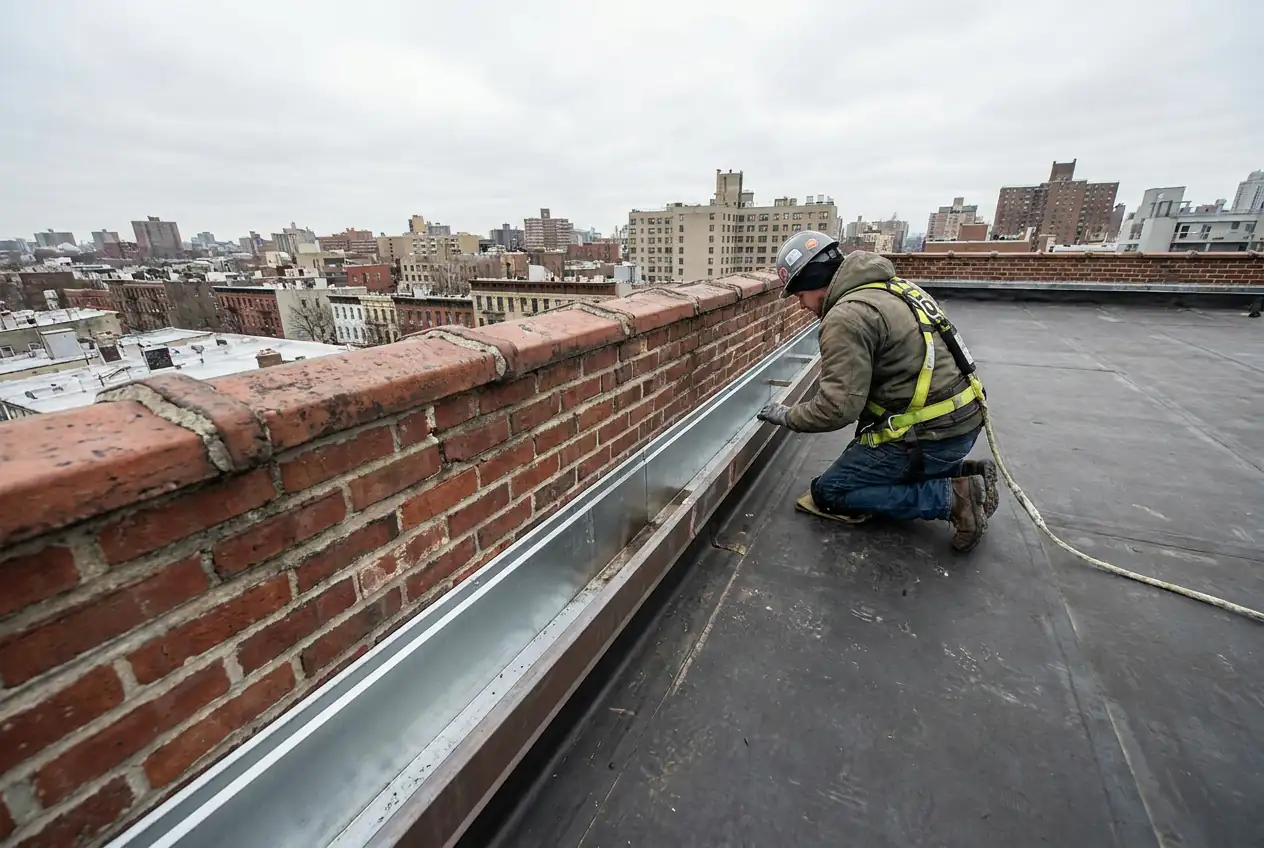
The six ways a trough gives up
Every survey checks all six, photographs what it finds and writes down which ones your roof actually has.
Lining options, with their honest lifespans
The survey around Minneapolis decides this, not the brochure. When a coat of liquid is the wrong answer we say so, and when it is the right one nobody will talk you into a rebuild.
Troughs we have stood in near Minneapolis
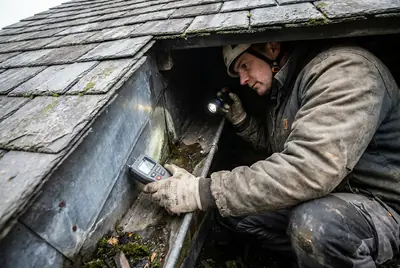
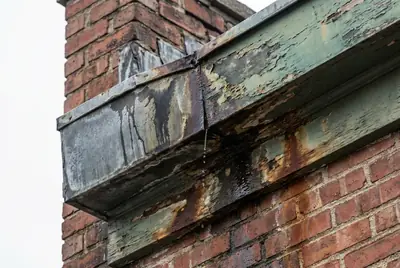
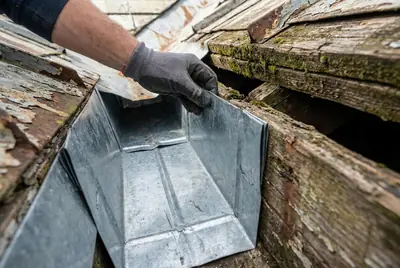
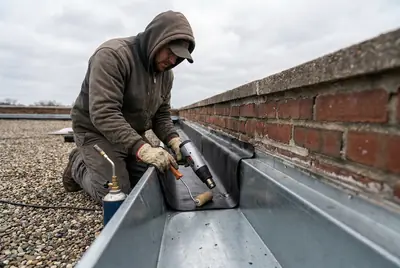
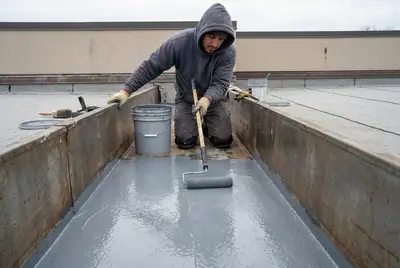
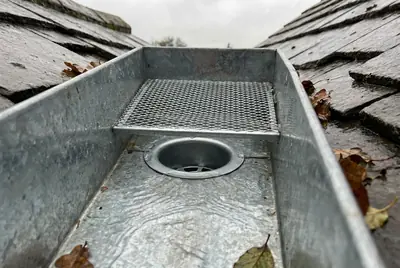
Homes that hide their gutters
Houses with history
Victorians, foursquares and rowhouses hide their gutters behind cornices and crown moldings, exactly where a ladder inspection never looks. The trough is often original, which means a century of patches over the first liner.
We work from the roof, keep the cornice profile intact and match liner details to the age of the house. The neighbors notice fresh paint, not our scaffold.
Flat roofs and additions
Parapet gutters on flat-roofed homes feed internal downpipes, so one blocked outlet can put water through every ceiling below. Porches and long additions add valley troughs that run well out of sight.
We schedule around family life, document every finding for you and your insurer, and can put the trough on a standing maintenance rota so the next blockage never becomes a claim.
Four moves, one dry house
- 1
Call the trough desk
One call to (844) 213-6324: ZIP code, what the gutter is doing and roughly when the home went up. Photos can wait for the survey, and the date is set before you hang up.
- 2
The roof survey
We walk the trough end to end in Minneapolis, meter the timber, photograph every junction and lift what needs lifting.
- 3
The report and the quote
One document: what is failing, what can wait, and what each fix costs. You keep it whichever way you decide.
- 4
The repair or the reline
Liner in, outlets flowing, and a hose test before the ladder comes down for the last time.
The price of a dry trough around Minneapolis
Length, access and how far the rot has traveled set the final number. The survey settles all three, and hearing the figure commits you to nothing.
Asked from under a stained ceiling
How do I know my house has a box gutter at all?
If the roof meets a parapet wall, if the front of the house is flat with no gutter visible from the sidewalk, or if two roof slopes meet over a wall, water is running through a built-in trough. Homes around Minneapolis put up before 1950 nearly always drain this way.
Why is the stain ten feet from where you found the hole?
Because water is a traveler. It leaves the trough at the failure, follows a beam or a wall cavity, and only drops when it runs out of road. Chasing the stain instead of the source is how houses end up with three patches and the same leak.
Can you reline the gutter without touching the rest of the roof?
Usually, yes. The liner sits inside the trough and is independent of the slates, shingles or membrane around it. We tie the new liner into the existing covering at the edges, and the rest of the roof never knows we were there.
Metal or membrane, which liner should I want?
The honest answer is the one that fits your trough, not the one with the best margin. Sound timber and straight runs favor folded metal for its lifespan. Twisting runs, many outlets or a tight budget favor rubber or liquid. The report prices what fits.
How disruptive is the work for the household below?
Less than a leak is. Nearly everything happens at roof level behind edge protection. Life at home carries on, and for occupied houses we sequence noisy cutting outside the hours that hurt.
What if you find the gutter boards are rotten?
Then the report says so, with photographs, and prices the rebuild as its own line. Nobody discovers a doubled invoice halfway through the job. Rot found at survey stage is a plan; rot found mid-reline is an argument, and we prefer plans.
The rooflines around Minneapolis
Zoom in on the flat roofs and parapets; the link ledgers below name every community our surveyors reach from here.
The ledger on Minneapolis
- Standing
- Incorporated place
- ZIP codes
- 55401, 55402, 55403, 55404, 69 codes in all
- Population
- 416,021 at the last count
- Land area
- 54.0 sq mi
- Density
- 7,704 people to the square mile
- Median household income
- $58,993
- County
- Hennepin County
- State
- Minnesota
- Census region
- Midwest
- Country
- United States
Parapets and rooflines of Minneapolis
- Box Gutter Repair in Armatage, Minneapolis
- Box Gutter Repair in Arts in Minneapolis, Minneapolis
- Box Gutter Repair in Audubon Park, Minneapolis
- Box Gutter Repair in Bancroft, Minneapolis
- Box Gutter Repair in Beltrami, Minneapolis
- Box Gutter Repair in Bottineau, Minneapolis
- Box Gutter Repair in Bryant, Minneapolis
- Box Gutter Repair in Bryn Mawr, Minneapolis
- Box Gutter Repair in Camden Industrial Area, Minneapolis
- Box Gutter Repair in Cedar-Isles-Dean, Minneapolis
- Box Gutter Repair in Cedar-Riverside, Minneapolis
- Box Gutter Repair in Central (neighborhood), Minneapolis
- Box Gutter Repair in Cleveland, Minneapolis
- Box Gutter Repair in Climate of Minneapolis–Saint Paul, Minneapolis
- Box Gutter Repair in Columbia Park, Minneapolis
- Box Gutter Repair in Como, Minneapolis
- Box Gutter Repair in Cooper, Minneapolis
- Box Gutter Repair in Corcoran, Minneapolis
- Box Gutter Repair in Demographics of Minneapolis, Minneapolis
- Box Gutter Repair in Diamond Lake, Minneapolis
- Box Gutter Repair in Downtown East, Minneapolis
- Box Gutter Repair in Downtown West, Minneapolis
- Box Gutter Repair in East Bde Maka Ska, Minneapolis
- Box Gutter Repair in East Harriet, Minneapolis
- Box Gutter Repair in East Isles, Minneapolis
- Box Gutter Repair in East Phillips, Minneapolis
- Box Gutter Repair in Elliot Park, Minneapolis
- Box Gutter Repair in Ericsson, Minneapolis
- Box Gutter Repair in Field, Minneapolis
- Box Gutter Repair in Flag of Minneapolis, Minneapolis
- Box Gutter Repair in Folwell, Minneapolis
- Box Gutter Repair in Fulton, Minneapolis
- Box Gutter Repair in Geography of Minneapolis, Minneapolis
- Box Gutter Repair in Government of Minneapolis, Minneapolis
- Box Gutter Repair in Hale, Minneapolis
- Box Gutter Repair in Harrison, Minneapolis
- Box Gutter Repair in Hawthorne, Minneapolis
- Box Gutter Repair in Hennepin County Library, Minneapolis
- Box Gutter Repair in Hiawatha, Minneapolis
- Box Gutter Repair in Holland, Minneapolis
Buildings we survey around Minneapolis
- Box Gutter Repair in Lauderdale, MN 3.1 mi by road
- Box Gutter Repair in Saint Anthony, MN 3.6 mi by road
- Box Gutter Repair in Columbia Heights, MN 4.2 mi by road
- Box Gutter Repair in Golden Valley, MN 4.6 mi by road
- Box Gutter Repair in Saint Louis Park, MN 4.7 mi by road
- Box Gutter Repair in Falcon Heights, MN 4.8 mi by road
- Box Gutter Repair in Robbinsdale, MN 5.1 mi by road
- Box Gutter Repair in Hilltop, MN 5.1 mi by road
- Box Gutter Repair in Roseville, MN 5.5 mi by road
- Box Gutter Repair in Crystal, MN 6 mi by road
- Box Gutter Repair in New Brighton, MN 6.6 mi by road
- Box Gutter Repair in Richfield, MN 6.7 mi by road
- Box Gutter Repair in Arden Hills, MN 7.1 mi by road
- Box Gutter Repair in New Hope, MN 7.2 mi by road
- Box Gutter Repair in Fridley, MN 7.3 mi by road
- Box Gutter Repair in Brooklyn Center, MN 7.4 mi by road
- Box Gutter Repair in Edina, MN 7.5 mi by road
- Box Gutter Repair in Medicine Lake, MN 7.5 mi by road
- Box Gutter Repair in Mendota, MN 8 mi by road
- Box Gutter Repair in Lilydale, MN 8.1 mi by road
Where Minnesota keeps its oldest roofs
- Box Gutter Repair in Minneapolis, MN 416,021 on the census
- Box Gutter Repair in Saint Paul, MN 302,760 on the census
- Box Gutter Repair in Rochester, MN 113,913 on the census
- Box Gutter Repair in Duluth, MN 86,004 on the census
- Box Gutter Repair in Bloomington, MN 85,394 on the census
- Box Gutter Repair in Brooklyn Park, MN 79,792 on the census
- Box Gutter Repair in Plymouth, MN 77,213 on the census
- Box Gutter Repair in Maple Grove, MN 69,571 on the census
- Box Gutter Repair in Woodbury, MN 68,686 on the census
- Box Gutter Repair in Saint Cloud, MN 67,513 on the census
- Box Gutter Repair in Eagan, MN 66,363 on the census
- Box Gutter Repair in Cedar Grove, MN 64,206 on the census
- Box Gutter Repair in Eden Prairie, MN 63,900 on the census
- Box Gutter Repair in Blaine, MN 63,319 on the census
- Box Gutter Repair in West Coon Rapids, MN 62,528 on the census
- Box Gutter Repair in Lakeville, MN 62,489 on the census
- Box Gutter Repair in Coon Rapids, MN 62,376 on the census
- Box Gutter Repair in Burnsville, MN 61,283 on the census
- Box Gutter Repair in Minnetonka, MN 52,546 on the census
- Box Gutter Repair in Apple Valley, MN 51,931 on the census
Somewhere above these streets a trough is quietly rusting.
Call (844) 213-6324