
Box Gutter Repair in Maryland (MD)
From farmhouse porches to Victorian blocks, Maryland runs on older homes with built-in gutters. We survey them, reline them and put every price on paper.
The call costs nothing and commits you to nothing. Any call-out fee for the survey is named when the date is set, and the written report follows the survey.
- Counties covered
- 24
- Region
- South
- Largest city
- Baltimore
Let's get that box gutter repair sorted out in Maryland.
Are Your Gutters Playing Hide and Seek with Rainwater
Imagine this: you're enjoying a quiet afternoon, and suddenly, you notice water isn't flowing where it should. Instead, it's making its own little waterfalls down your siding or pooling around your foundation. That's precisely the kind of headache that a problem with your box gutter system can cause. These aren't just decorative bits up there they are your home's first line of defense against water damage, and when they falter, things can get messy, fast.
This vital system directs rainwater away from your house's structure, preventing all sorts of nasty issues like basement flooding, mold growth, and even damage to your landscaping. When you see those telltale drips and overflows, it's your cue that something needs attention, and ignoring it can lead to some seriously expensive repairs down the line. So, let's dive into what's really going on when your gutters aren't doing their job.
The Nitty Gritty of Gutter Woes
So, what exactly goes wrong with these hardworking channels that snake around your roofline? It's usually a combination of things, from simple clogs to more serious structural issues. Understanding these common culprits is the first step in getting your Maryland home protected.
Now, one of the most frequent offenders is good old debris. Leaves, twigs, shingle grit, and even the occasional bird's nest can build up, creating miniature dams that stop water dead in its tracks. And this blockage isn't just an inconvenience; it forces water to back up, which can then seep under your shingles or find its way into your fascia boards, the wooden trim behind the gutters. It's like a slow, silent invasion.
Then there's the physical wear and tear. Over time, especially with Maryland's varied weather, your gutters can start to sag, pull away from the house, or even develop small holes. This can happen due to the weight of ice in winter, strong winds, or just the natural aging of the materials. And when they're not pitched correctly, water will inevitably pool, accelerating corrosion and leading to leaks that you definitely don't want.
The Leaky Truth About Seams and Joints
You see, your entire gutter system is made up of sections that are joined together. And where there are joins, there are potential weak spots. These seams are often sealed with a special gutter sealant to keep water from escaping, but that sealant can dry out, crack, or even detach over time. And that's your invitation for drips and dribbles to start their unwanted journey down your walls.
This is particularly true for older homes or those with certain types of gutter materials that might be more prone to expansion and contraction with temperature changes. If you notice water consistently weeping from a specific spot along the gutter's length, it's a pretty good indicator that one of these seals has given up the ghost. Addressing these small leaks promptly can prevent them from becoming much larger, more pervasive problems.
Why Ignoring Gutter Issues is a Bad Idea
Think of your gutters as the unsung heroes of your home's exterior. They work tirelessly, day in and day out, to keep water at bay. When they're not functioning as they should, the consequences can ripple throughout your entire property, leading to a cascade of more significant and often costly problems. It's really about proactive care.
For instance, water that isn't properly channeled away from your foundation can find its way into your basement or crawl space. This moisture is a breeding ground for mold and mildew, which can cause structural damage and pose serious health risks to your family. Plus, constantly saturated soil around your foundation can lead to hydrostatic pressure, potentially cracking your foundation walls. Nobody wants that kind of structural drama.
The Siding and Exterior's Silent Suffering
Moreover, that same errant water can wreak havoc on your home's siding. Constant exposure to moisture can cause wood siding to rot, paint to peel, and even vinyl siding to warp or crack. And let's not even get started on the potential for ice dams to form in colder months when water freezes and thaws repeatedly, causing damage that's a real pain to fix. Your home's exterior deserves better than to be a water park.
And for those of you living in areas of Maryland with lovely gardens or meticulously kept flower beds near your home, overflowing gutters can mean disaster. You might find your prized azaleas or vibrant petunias getting washed away or drowned by the deluge, turning your beautiful landscaping into a muddy mess. It's a shame to see all that hard work go down the drain, quite literally.
What to Look for in a Gutter Repair Professional
When you decide it's time to tackle those leaky or clogged box gutters, you'll want to bring in someone who really knows their stuff. It's not just about slapping some caulk on a hole; it's about understanding the whole system and making sure the repair is done right. You're looking for someone who can diagnose the problem accurately and provide a lasting solution.
You'll want to seek out a local professional who has a good grasp of Maryland's specific weather patterns and building codes. They should be able to explain exactly what's wrong with your gutters, why it's happening, and what they plan to do to fix it, using clear, understandable language. A good pro won't just patch it up; they'll aim to restore the integrity of your entire gutter system.
Questions to Ask and Things to Check
When you're chatting with potential repair people, don't be shy about asking questions. For example, you might inquire about the materials they use for repairs and if they offer any kind of assurance on their workmanship. It's also wise to ask if they have experience with the specific type of box gutters you have on your home, as there can be subtle differences in installation and repair techniques.
And remember, a truly reputable professional will be happy to provide you with an estimate that details the scope of work and the associated costs. They should also be able to explain their process for handling your specific gutter issue, whether it's a minor leak, a section that needs replacing, or a complete system blockage. This transparency is key to a stress-free experience.
You're looking for someone who will treat your home with respect, ensuring that the repair process is as tidy and efficient as possible. This means they should take steps to protect your landscaping and home's exterior while they work, and clean up thoroughly afterward. Ultimately, you want to feel confident that you've hired someone who will get the job done right, leaving your gutters in tip-top shape.
Getting Your Gutters Back in Top Shape
Dealing with gutter problems can feel like a hassle, but the good news is that getting them fixed is usually straightforward when you connect with the right help. You're basically aiming to restore your home's natural defense against the elements, ensuring everything stays dry and protected. It's about peace of mind, honestly.
So, if you're noticing water pooling where it shouldn't, or those telltale drips are becoming a constant soundtrack to your day, don't wait too long. Reach out for a free quote today. You'll get connected with local pros who understand how to keep your Maryland home safe and sound, one perfectly functioning gutter at a time.
What a box gutter is, and why yours leaks
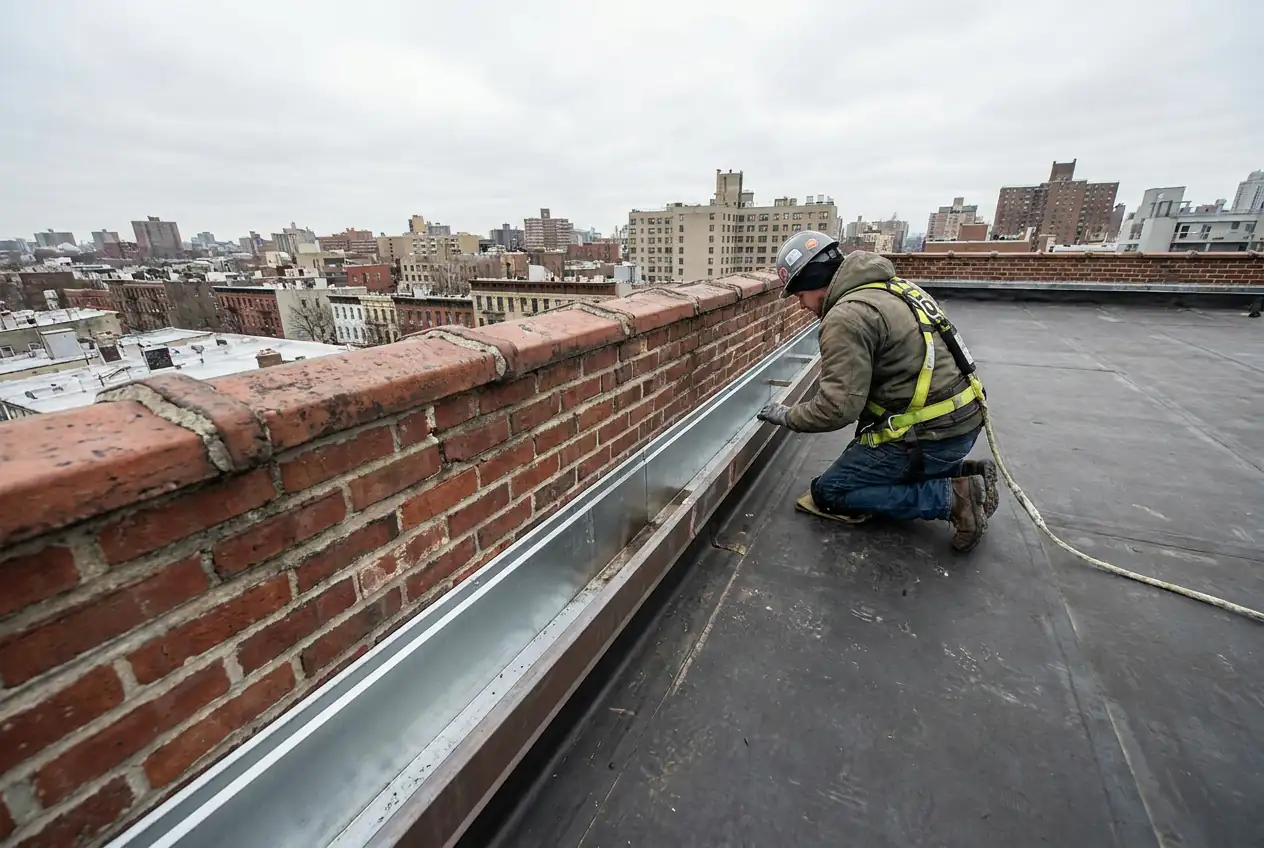
A box gutter does not hang off the roof edge. It is built into the roof itself: a timber trough lined with metal or membrane, running behind a parapet wall or tucked between two roof slopes. Nearly every American home put up before 1950 with a flat front, and plenty of flat-roofed additions since, drains through one.
That hidden position is the whole problem. A hanging gutter fails in public, dripping where you can see it. A box gutter fails inward. The trough floor rusts through or a joint opens, and the water takes the shortest path into the house: along a beam, down a wall cavity, out through a ceiling ten feet from the actual hole.
By the time a stain appears, the leak has usually been running for seasons. This is why we open every job with a survey rather than a sales pitch. Someone has to stand in the trough, meter the timber and find out which of the six classic failures is at work before any fix is worth pricing.
The six ways a trough gives up
Every survey checks all six, photographs what it finds and writes down which ones your roof actually has.
Lining options, with their honest lifespans
The survey decides this, not the brochure. When a coat of liquid is the wrong answer we say so, and when it is the right one nobody will talk you into a rebuild.
Troughs we have stood in
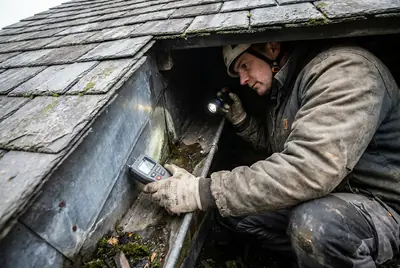
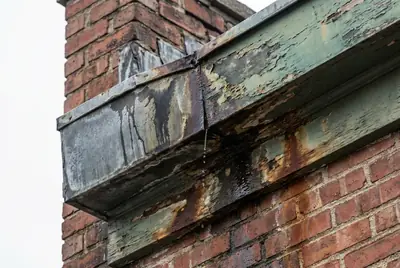
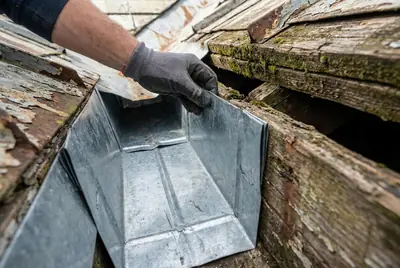
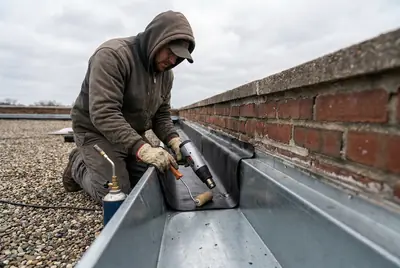
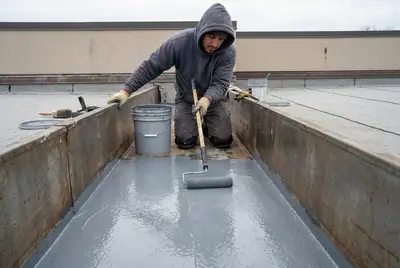
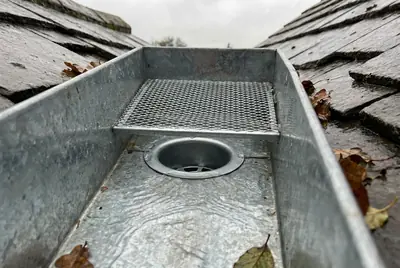
Homes that hide their gutters
Houses with history
Victorians, foursquares and rowhouses hide their gutters behind cornices and crown moldings, exactly where a ladder inspection never looks. The trough is often original, which means a century of patches over the first liner.
We work from the roof, keep the cornice profile intact and match liner details to the age of the house. The neighbors notice fresh paint, not our scaffold.
Flat roofs and additions
Parapet gutters on flat-roofed homes feed internal downpipes, so one blocked outlet can put water through every ceiling below. Porches and long additions add valley troughs that run well out of sight.
We schedule around family life, document every finding for you and your insurer, and can put the trough on a standing maintenance rota so the next blockage never becomes a claim.
Four moves, one dry house
- 1
Call the trough desk
One call to (844) 213-6324: ZIP code, what the gutter is doing and roughly when the home went up. Photos can wait for the survey, and the date is set before you hang up.
- 2
The roof survey
We walk the trough end to end, meter the timber, photograph every junction and lift what needs lifting.
- 3
The report and the quote
One document: what is failing, what can wait, and what each fix costs. You keep it whichever way you decide.
- 4
The repair or the reline
Liner in, outlets flowing, and a hose test before the ladder comes down for the last time.
The price of a dry trough
Length, access and how far the rot has traveled set the final number. The survey settles all three, and hearing the figure commits you to nothing.
Asked from under a stained ceiling
How do I know my house has a box gutter at all?
If the roof meets a parapet wall, if the front of the house is flat with no gutter visible from the sidewalk, or if two roof slopes meet over a wall, water is running through a built-in trough. Homes put up before 1950 nearly always drain this way.
Why is the stain ten feet from where you found the hole?
Because water is a traveler. It leaves the trough at the failure, follows a beam or a wall cavity, and only drops when it runs out of road. Chasing the stain instead of the source is how houses end up with three patches and the same leak.
Can you reline the gutter without touching the rest of the roof?
Usually, yes. The liner sits inside the trough and is independent of the slates, shingles or membrane around it. We tie the new liner into the existing covering at the edges, and the rest of the roof never knows we were there.
Metal or membrane, which liner should I want?
The honest answer is the one that fits your trough, not the one with the best margin. Sound timber and straight runs favor folded metal for its lifespan. Twisting runs, many outlets or a tight budget favor rubber or liquid. The report prices what fits.
How disruptive is the work for the household below?
Less than a leak is. Nearly everything happens at roof level behind edge protection. Life at home carries on, and for occupied houses we sequence noisy cutting outside the hours that hurt.
What if you find the gutter boards are rotten?
Then the report says so, with photographs, and prices the rebuild as its own line. Nobody discovers a doubled invoice halfway through the job. Rot found at survey stage is a plan; rot found mid-reline is an argument, and we prefer plans.
The rooflines around Maryland
Zoom in on the flat roofs and parapets; the link ledgers below name every community our surveyors reach from here.
Maryland: every county on the ledger
- Box Gutter Repair in Allegany County, MD
- Box Gutter Repair in Anne Arundel County, MD
- Box Gutter Repair in Baltimore County, MD
- Box Gutter Repair in Calvert County, MD
- Box Gutter Repair in Caroline County, MD
- Box Gutter Repair in Carroll County, MD
- Box Gutter Repair in Cecil County, MD
- Box Gutter Repair in Charles County, MD
- Box Gutter Repair in City of Baltimore, MD
- Box Gutter Repair in Dorchester County, MD
- Box Gutter Repair in Frederick County, MD
- Box Gutter Repair in Garrett County, MD
- Box Gutter Repair in Harford County, MD
- Box Gutter Repair in Howard County, MD
- Box Gutter Repair in Kent County, MD
- Box Gutter Repair in Montgomery County, MD
- Box Gutter Repair in Prince George's County, MD
- Box Gutter Repair in Queen Anne's County, MD
- Box Gutter Repair in Saint Mary's County, MD
- Box Gutter Repair in Somerset County, MD
- Box Gutter Repair in Talbot County, MD
- Box Gutter Repair in Washington County, MD
- Box Gutter Repair in Wicomico County, MD
- Box Gutter Repair in Worcester County, MD
The towns that built Maryland
- Box Gutter Repair in Baltimore, MD 614,700 on the census
- Box Gutter Repair in Columbia, MD 103,663 on the census
- Box Gutter Repair in Germantown, MD 90,844 on the census
- Box Gutter Repair in Silver Spring, MD 79,750 on the census
- Box Gutter Repair in Waldorf, MD 74,587 on the census
- Box Gutter Repair in Frederick, MD 70,166 on the census
- Box Gutter Repair in Glen Burnie, MD 69,813 on the census
- Box Gutter Repair in Gaithersburg, MD 67,529 on the census
- Box Gutter Repair in Rockville, MD 67,062 on the census
- Box Gutter Repair in Ellicott City, MD 65,834 on the census
- Box Gutter Repair in Dundalk, MD 62,768 on the census
- Box Gutter Repair in Bethesda, MD 62,448 on the census
- Box Gutter Repair in Bowie, MD 58,368 on the census
- Box Gutter Repair in Towson, MD 58,347 on the census
- Box Gutter Repair in Wheaton-Glenmont, MD 57,694 on the census
- Box Gutter Repair in Clarksville, MD 56,239 on the census
- Box Gutter Repair in Baynesville, MD 55,197 on the census
- Box Gutter Repair in Aspen Hill, MD 52,807 on the census
- Box Gutter Repair in Wheaton, MD 50,459 on the census
- Box Gutter Repair in North Bethesda, MD 50,262 on the census
- Box Gutter Repair in Severn, MD 50,052 on the census
- Box Gutter Repair in South Bel Air, MD 48,828 on the census
- Box Gutter Repair in Bel Air South, MD 48,269 on the census
- Box Gutter Repair in Potomac, MD 45,824 on the census
- Box Gutter Repair in Odenton, MD 41,846 on the census
- Box Gutter Repair in Westview, MD 41,567 on the census
- Box Gutter Repair in Catonsville, MD 41,515 on the census
- Box Gutter Repair in Essex, MD 40,480 on the census
- Box Gutter Repair in Hagerstown, MD 40,186 on the census
- Box Gutter Repair in Clinton, MD 40,027 on the census
Also under South skies
- Box Gutter Repair in Alabama
- Box Gutter Repair in Arkansas
- Box Gutter Repair in Delaware
- Box Gutter Repair in Florida
- Box Gutter Repair in Georgia
- Box Gutter Repair in Kentucky
- Box Gutter Repair in Louisiana
- Box Gutter Repair in Mississippi
- Box Gutter Repair in North Carolina
- Box Gutter Repair in Oklahoma
- Box Gutter Repair in South Carolina
- Box Gutter Repair in Tennessee
- Box Gutter Repair in Texas
- Box Gutter Repair in Virginia
- Box Gutter Repair in Washington, D.C.
- Box Gutter Repair in West Virginia
Somewhere above these streets a trough is quietly rusting.
Call (844) 213-6324