
Box Gutter Repair in Thayer County, Nebraska (NE)
Across Thayer County, we keep the box gutters of farmhouses, rowhouses and older homes doing their quiet job: survey first, then a liner or rebuild priced in writing.
The call costs nothing and commits you to nothing. Any call-out fee for the survey is named when the date is set, and the written report follows the survey.
Fixing Those Heavy Metal Channels Above Your Roof Line
Keeping your home dry starts with managing the flow of rain across your roof edges. These classic horizontal troughs often trap debris and eventually rust through if you ignore the buildup. You need someone in Thayer County to inspect the seams and restore the watertight integrity of these structural elements before water seeps into your interior walls.
Understanding Why These Deep Channels Need Care
Heavy rain creates significant pressure on your drainage system when the water has nowhere to go. Older homes often feature these custom metal liners that sit directly inside the building frame. They hold much more weight than standard hanging units, which means any weakness leads to major internal damage very fast.
Because these channels sit inside the roof structure, leaks often go unnoticed until the ceiling shows spots. Ignoring these signs creates a perfect environment for wood rot and mold growth. Catching the rust early saves you the headache of replacing entire roof sections later.
The Value of Proper Maintenance and Repair
Skilled hands will clear out years of leaves and shingle grit that act like sponges. Cleaning these areas removes the weight that pulls fasteners away from the wood. This simple action prevents sagging sections that cause standing water and mosquito breeding grounds.
Good repairs involve sealing the metal seams with high-grade compounds that flex with temperature swings. This flexibility ensures your home stays dry even during the harshest Nebraska winter. You get peace of mind knowing the runoff stays outside where it belongs.
| Common Issues | Impact on Your Home |
| Clogged debris | Water backup and overflow |
| Failed sealants | Structural wood decay |
| Rust holes | Ceiling and wall damage |
What to Look for in a Local Pro
Finding the right person for this job matters because these systems require specific knowledge of custom sheet metal work. Always ask for a licensed and insured technician to handle your drainage needs. A knowledgeable crew understands the local code and ensures the slope points exactly toward the downspouts.
Checking for a written warranty helps you sleep better once the job finishes. You want someone who offers a clear plan for your project without hidden fees or surprise costs. A local worker familiar with the area climate will know exactly how much capacity your home needs to manage heavy thunderstorms effectively.
Taking the Next Step for Your Roof
Protecting your investment is much easier when you have the right information at your fingertips. You can request a free quote today to understand the scope of your specific gutter needs. Simply describe your current setup and let local professionals provide a no obligation estimate for the necessary work.
Getting started early prevents small drips from turning into expensive disasters. You deserve a dry home and a solid roof over your head. Reach out now to connect with experts who serve this region and get your drainage back in perfect shape.
What a box gutter is, and why yours leaks
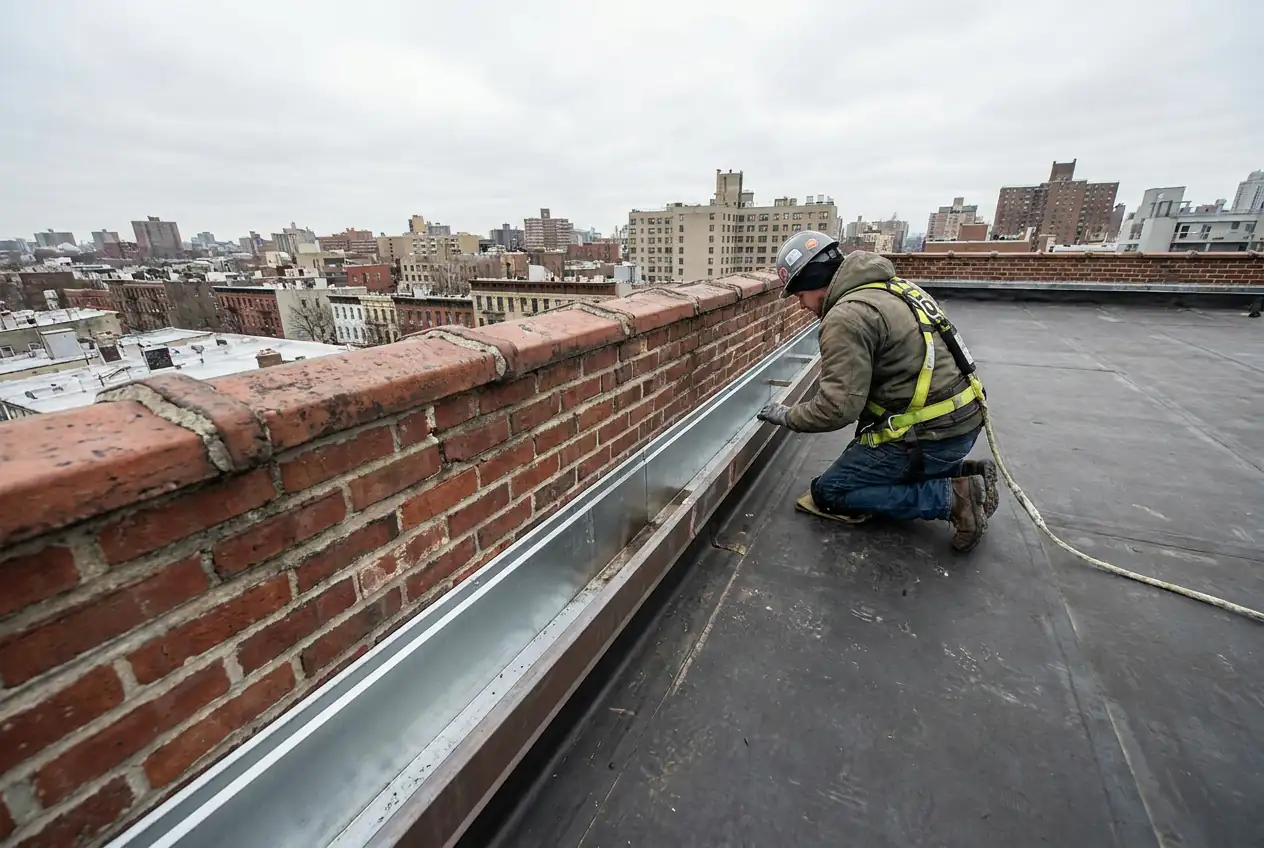
A box gutter does not hang off the roof edge. It is built into the roof itself: a timber trough lined with metal or membrane, running behind a parapet wall or tucked between two roof slopes. Nearly every American home put up before 1950 with a flat front, and plenty of flat-roofed additions since, drains through one.
That hidden position is the whole problem. A hanging gutter fails in public, dripping where you can see it. A box gutter fails inward. The trough floor rusts through or a joint opens, and the water takes the shortest path into the house: along a beam, down a wall cavity, out through a ceiling ten feet from the actual hole.
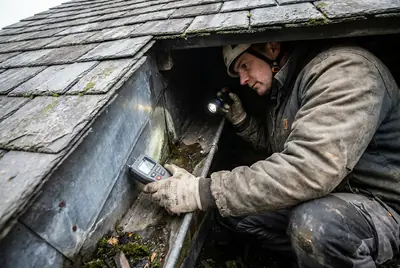
By the time a stain appears, the leak has usually been running for seasons. This is why we open every job with a survey rather than a sales pitch. Someone has to stand in the trough, meter the timber and find out which of the six classic failures is at work before any fix is worth pricing.
The six ways a trough gives up
Every survey checks all six, photographs what it finds and writes down which ones your roof actually has.
Lining options, with their honest lifespans
The survey decides this, not the brochure. When a coat of liquid is the wrong answer we say so, and when it is the right one nobody will talk you into a rebuild.
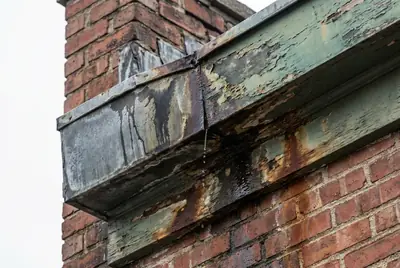
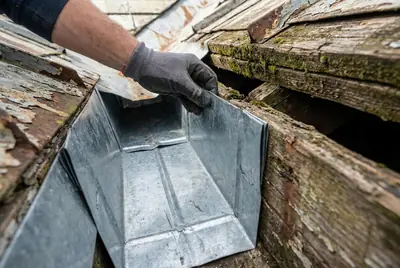
Troughs we have stood in
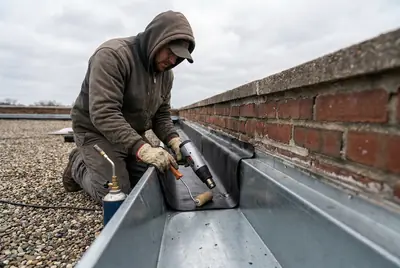
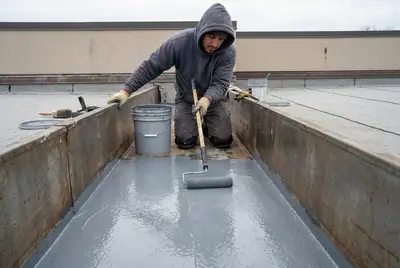
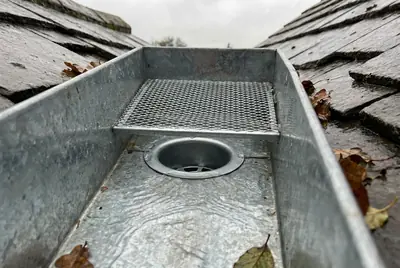
Homes that hide their gutters
Houses with history
Victorians, foursquares and rowhouses hide their gutters behind cornices and crown moldings, exactly where a ladder inspection never looks. The trough is often original, which means a century of patches over the first liner.
We work from the roof, keep the cornice profile intact and match liner details to the age of the house. The neighbors notice fresh paint, not our scaffold.
Flat roofs and additions
Parapet gutters on flat-roofed homes feed internal downpipes, so one blocked outlet can put water through every ceiling below. Porches and long additions add valley troughs that run well out of sight.
We schedule around family life, document every finding for you and your insurer, and can put the trough on a standing maintenance rota so the next blockage never becomes a claim.
Four moves, one dry house
- 1
Call the trough desk
One call to (844) 213-6324: ZIP code, what the gutter is doing and roughly when the home went up. Photos can wait for the survey, and the date is set before you hang up.
- 2
The roof survey
We walk the trough end to end, meter the timber, photograph every junction and lift what needs lifting.
- 3
The report and the quote
One document: what is failing, what can wait, and what each fix costs. You keep it whichever way you decide.
- 4
The repair or the reline
Liner in, outlets flowing, and a hose test before the ladder comes down for the last time.
The price of a dry trough
Length, access and how far the rot has traveled set the final number. The survey settles all three, and hearing the figure commits you to nothing.
Asked from under a stained ceiling
How do I know my house has a box gutter at all?
If the roof meets a parapet wall, if the front of the house is flat with no gutter visible from the sidewalk, or if two roof slopes meet over a wall, water is running through a built-in trough. Homes put up before 1950 nearly always drain this way.
Why is the stain ten feet from where you found the hole?
Because water is a traveler. It leaves the trough at the failure, follows a beam or a wall cavity, and only drops when it runs out of road. Chasing the stain instead of the source is how houses end up with three patches and the same leak.
Can you reline the gutter without touching the rest of the roof?
Usually, yes. The liner sits inside the trough and is independent of the slates, shingles or membrane around it. We tie the new liner into the existing covering at the edges, and the rest of the roof never knows we were there.
Metal or membrane, which liner should I want?
The honest answer is the one that fits your trough, not the one with the best margin. Sound timber and straight runs favor folded metal for its lifespan. Twisting runs, many outlets or a tight budget favor rubber or liquid. The report prices what fits.
How disruptive is the work for the household below?
Less than a leak is. Nearly everything happens at roof level behind edge protection. Life at home carries on, and for occupied houses we sequence noisy cutting outside the hours that hurt.
What if you find the gutter boards are rotten?
Then the report says so, with photographs, and prices the rebuild as its own line. Nobody discovers a doubled invoice halfway through the job. Rot found at survey stage is a plan; rot found mid-reline is an argument, and we prefer plans.
The rooflines around Thayer County
Zoom in on the flat roofs and parapets; the link ledgers below name every community our surveyors reach from here.
Every town worth a survey in Thayer County
- Box Gutter Repair in Hebron, NE 1,694 on the census
- Box Gutter Repair in Deshler, NE 711 on the census
- Box Gutter Repair in Davenport, NE 358 on the census
- Box Gutter Repair in Bruning, NE 287 on the census
- Box Gutter Repair in Chester, NE 268 on the census
- Box Gutter Repair in Alexandria, NE 153 on the census
- Box Gutter Repair in Carleton, NE 98 on the census
- Box Gutter Repair in Byron, NE 95 on the census
- Box Gutter Repair in Hubbell, NE 80 on the census
- Box Gutter Repair in Belvidere, NE 38 on the census
- Box Gutter Repair in Gilead, NE 27 on the census
Onward through Nebraska, county after county
- Box Gutter Repair in Adams County, NE
- Box Gutter Repair in Antelope County, NE
- Box Gutter Repair in Arthur County, NE
- Box Gutter Repair in Banner County, NE
- Box Gutter Repair in Blaine County, NE
- Box Gutter Repair in Boone County, NE
- Box Gutter Repair in Box Butte County, NE
- Box Gutter Repair in Boyd County, NE
- Box Gutter Repair in Brown County, NE
- Box Gutter Repair in Buffalo County, NE
- Box Gutter Repair in Burt County, NE
- Box Gutter Repair in Butler County, NE
- Box Gutter Repair in Cass County, NE
- Box Gutter Repair in Cedar County, NE
- Box Gutter Repair in Chase County, NE
- Box Gutter Repair in Cherry County, NE
- Box Gutter Repair in Cheyenne County, NE
- Box Gutter Repair in Clay County, NE
- Box Gutter Repair in Colfax County, NE
- Box Gutter Repair in Cuming County, NE
- Box Gutter Repair in Custer County, NE
- Box Gutter Repair in Dakota County, NE
- Box Gutter Repair in Dawes County, NE
- Box Gutter Repair in Dawson County, NE
- Box Gutter Repair in Deuel County, NE
- Box Gutter Repair in Dixon County, NE
- Box Gutter Repair in Dodge County, NE
- Box Gutter Repair in Douglas County, NE
- Box Gutter Repair in Dundy County, NE
- Box Gutter Repair in Fillmore County, NE
Somewhere above these streets a trough is quietly rusting.
Call (844) 213-6324