
Box Gutter Repair in Nevada (NV)
From farmhouse porches to Victorian blocks, Nevada runs on older homes with built-in gutters. We survey them, reline them and put every price on paper.
The call costs nothing and commits you to nothing. Any call-out fee for the survey is named when the date is set, and the written report follows the survey.
- Counties covered
- 17
- Region
- West
- Largest city
- Las Vegas
Restoring your metal drainage channels in Nevada
Getting your roof drainage back in shape involves sealing joints and clearing debris from those heavy rectangular troughs. Professionals around here fix these built-in metal pathways to stop water from backing up into your attic space or rotting the wooden fascia boards.
Why these troughs need specialized care
These integrated metallic systems hide within the roofline and require specific skills to keep them flowing properly. Because they sit flush against your home, any tiny crack lets water seep directly into the structural frame. That penetration leads to expensive wood rot and mold growth over time.
Fixing these requires meticulous attention to the seams where metal meets wood. A skilled hand uses high-grade sealant to bridge these gaps so you avoid leaks during the rainy season. This watertight seal prevents moisture from reaching your interior walls.
Dealing with the local climate challenges
High desert heat makes metal expand and contract more than in other regions. This constant movement causes the joints to pull apart and create gaps that invite water inside. You should have a professional inspect the expansion joints regularly to maintain a watertight barrier.
Cold nights cause the material to shrink again after those hot days. This cycle puts immense stress on the fasteners and solder points holding everything together. A sturdy repair job reinforces these weak spots so your home stays safe during temperature swings.
| Common issue | Resulting benefit |
| Clogged drains | Prevents foundation erosion |
| Loose seams | Stops wall saturation |
| Corroded metal | Extends roof life |
What to look for in a local pro
Finding someone who understands the complexity of these rectangular systems is vital for long-term success. You must ensure that any person you hire has valid insurance and a license to operate in this state. That protection gives you peace of mind throughout the entire process.
Ask your potential hire about their experience with custom soldering or high-quality elastomeric coatings. These methods provide superior drainage integrity while resisting the harsh sunlight found across the Silver State. Choosing the right method means you avoid repeated repairs down the road.
Common signs of trouble
You might notice water dripping behind the fascia during a light shower. This occurrence usually means the inner lining has failed or the drainage outlet is blocked. Prompt action here saves you from needing a full replacement of the roof structure later on.
Stains appearing on your ceiling are another warning that the system is failing you. Water follows the path of least resistance and often tracks along roof rafters. Getting a quick assessment lets you stop the damage before it ruins your drywall or insulation.
Taking the next step
Addressing these issues early prevents much larger headaches that cost a fortune to fix. You should reach out to get a free quote from a qualified local professional today. This simple act starts your journey toward a dry and secure home interior.
Getting clarity on the cost and scope of work helps you plan your maintenance budget effectively. Simply describe your current project to receive a quick reply from someone serving this area. That connection ensures you get the reliable craftsmanship your property deserves right now.
Essential features for long-term protection
A well-repaired drainage system uses advanced materials to handle the heavy runoff common in stormy weather. Proper pitch adjustment ensures that every drop of water flows toward the downspouts instead of sitting stagnant in the channel. This gravity-fed flow provides a lasting solution for your moisture worries.
Strong metal flashing serves as your primary defense against leaks where the roof meets the channel. Proper installation of this flashing creates a seamless transition that sheds water efficiently. That engineering precision protects the vulnerable edges of your roof deck for many years.
Maintenance habits for homeowners
Clearing out the pine needles and desert dust at least twice a year keeps the system working as intended. Removing this buildup prevents heavy debris from trapping moisture against the metal. This simple habit promotes structural longevity for your entire house.
Checking the downspouts for blockages is equally important for maintaining proper drainage throughout the property. When water flows freely, it avoids overflowing and splashing against your home foundation. That clear path saves you money by preventing costly repairs caused by water damage.
Final advice on your project
You deserve a home that feels secure and dry regardless of the weather conditions. Taking care of your roof drainage system is an investment in the health of your building. Simply request your free quote now to start fixing those troublesome spots around your roofline.
What a box gutter is, and why yours leaks
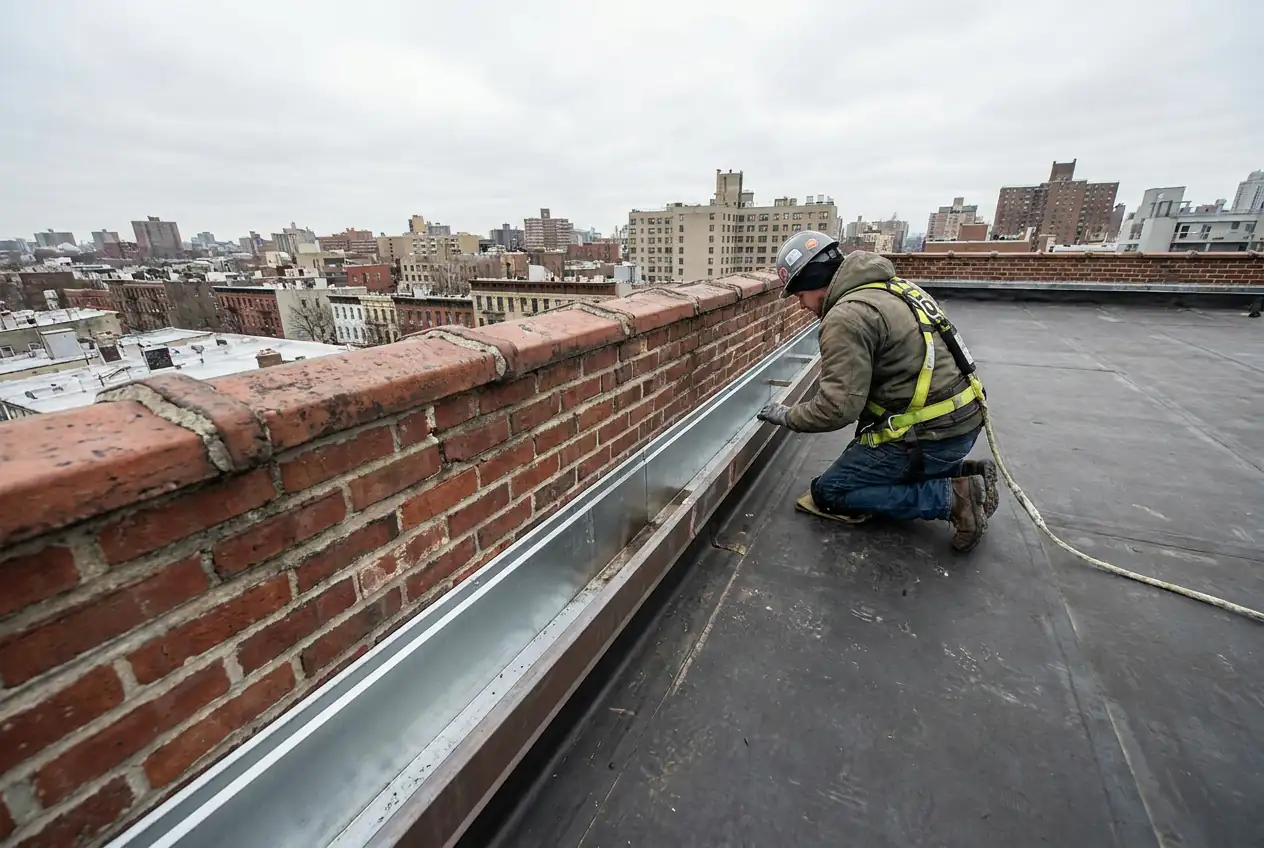
A box gutter does not hang off the roof edge. It is built into the roof itself: a timber trough lined with metal or membrane, running behind a parapet wall or tucked between two roof slopes. Nearly every American home put up before 1950 with a flat front, and plenty of flat-roofed additions since, drains through one.
That hidden position is the whole problem. A hanging gutter fails in public, dripping where you can see it. A box gutter fails inward. The trough floor rusts through or a joint opens, and the water takes the shortest path into the house: along a beam, down a wall cavity, out through a ceiling ten feet from the actual hole.
By the time a stain appears, the leak has usually been running for seasons. This is why we open every job with a survey rather than a sales pitch. Someone has to stand in the trough, meter the timber and find out which of the six classic failures is at work before any fix is worth pricing.
The six ways a trough gives up
Every survey checks all six, photographs what it finds and writes down which ones your roof actually has.
Lining options, with their honest lifespans
The survey decides this, not the brochure. When a coat of liquid is the wrong answer we say so, and when it is the right one nobody will talk you into a rebuild.
Troughs we have stood in
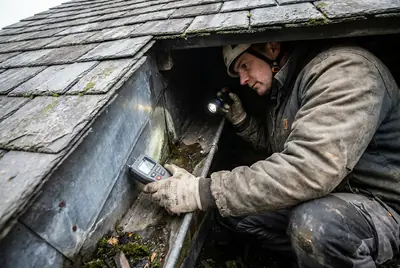
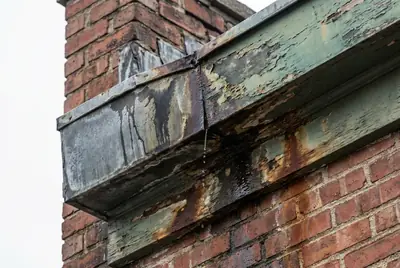
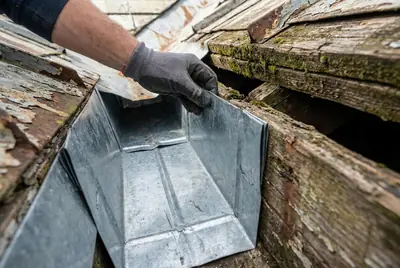
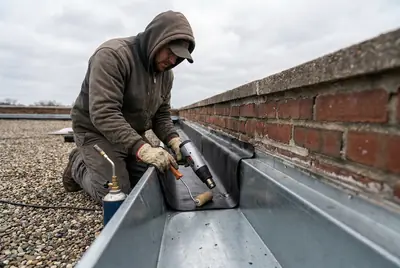
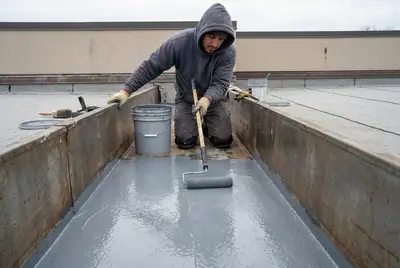
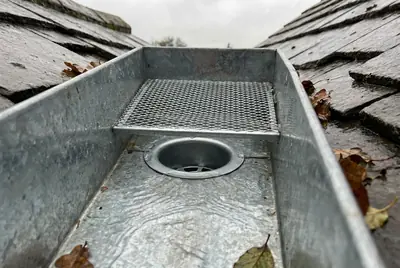
Homes that hide their gutters
Houses with history
Victorians, foursquares and rowhouses hide their gutters behind cornices and crown moldings, exactly where a ladder inspection never looks. The trough is often original, which means a century of patches over the first liner.
We work from the roof, keep the cornice profile intact and match liner details to the age of the house. The neighbors notice fresh paint, not our scaffold.
Flat roofs and additions
Parapet gutters on flat-roofed homes feed internal downpipes, so one blocked outlet can put water through every ceiling below. Porches and long additions add valley troughs that run well out of sight.
We schedule around family life, document every finding for you and your insurer, and can put the trough on a standing maintenance rota so the next blockage never becomes a claim.
Four moves, one dry house
- 1
Call the trough desk
One call to (844) 213-6324: ZIP code, what the gutter is doing and roughly when the home went up. Photos can wait for the survey, and the date is set before you hang up.
- 2
The roof survey
We walk the trough end to end, meter the timber, photograph every junction and lift what needs lifting.
- 3
The report and the quote
One document: what is failing, what can wait, and what each fix costs. You keep it whichever way you decide.
- 4
The repair or the reline
Liner in, outlets flowing, and a hose test before the ladder comes down for the last time.
The price of a dry trough
Length, access and how far the rot has traveled set the final number. The survey settles all three, and hearing the figure commits you to nothing.
Asked from under a stained ceiling
How do I know my house has a box gutter at all?
If the roof meets a parapet wall, if the front of the house is flat with no gutter visible from the sidewalk, or if two roof slopes meet over a wall, water is running through a built-in trough. Homes put up before 1950 nearly always drain this way.
Why is the stain ten feet from where you found the hole?
Because water is a traveler. It leaves the trough at the failure, follows a beam or a wall cavity, and only drops when it runs out of road. Chasing the stain instead of the source is how houses end up with three patches and the same leak.
Can you reline the gutter without touching the rest of the roof?
Usually, yes. The liner sits inside the trough and is independent of the slates, shingles or membrane around it. We tie the new liner into the existing covering at the edges, and the rest of the roof never knows we were there.
Metal or membrane, which liner should I want?
The honest answer is the one that fits your trough, not the one with the best margin. Sound timber and straight runs favor folded metal for its lifespan. Twisting runs, many outlets or a tight budget favor rubber or liquid. The report prices what fits.
How disruptive is the work for the household below?
Less than a leak is. Nearly everything happens at roof level behind edge protection. Life at home carries on, and for occupied houses we sequence noisy cutting outside the hours that hurt.
What if you find the gutter boards are rotten?
Then the report says so, with photographs, and prices the rebuild as its own line. Nobody discovers a doubled invoice halfway through the job. Rot found at survey stage is a plan; rot found mid-reline is an argument, and we prefer plans.
The rooflines around Nevada
Zoom in on the flat roofs and parapets; the link ledgers below name every community our surveyors reach from here.
Nevada: every county on the ledger
- Box Gutter Repair in Carson City, NV
- Box Gutter Repair in Churchill County, NV
- Box Gutter Repair in Clark County, NV
- Box Gutter Repair in Douglas County, NV
- Box Gutter Repair in Elko County, NV
- Box Gutter Repair in Esmeralda County, NV
- Box Gutter Repair in Eureka County, NV
- Box Gutter Repair in Humboldt County, NV
- Box Gutter Repair in Lander County, NV
- Box Gutter Repair in Lincoln County, NV
- Box Gutter Repair in Lyon County, NV
- Box Gutter Repair in Mineral County, NV
- Box Gutter Repair in Nye County, NV
- Box Gutter Repair in Pershing County, NV
- Box Gutter Repair in Storey County, NV
- Box Gutter Repair in Washoe County, NV
- Box Gutter Repair in White Pine County, NV
The towns that built Nevada
- Box Gutter Repair in Las Vegas, NV 626,637 on the census
- Box Gutter Repair in Henderson, NV 291,346 on the census
- Box Gutter Repair in Reno, NV 242,633 on the census
- Box Gutter Repair in North Las Vegas, NV 236,986 on the census
- Box Gutter Repair in Paradise, NV 233,689 on the census
- Box Gutter Repair in West Reno, NV 225,221 on the census
- Box Gutter Repair in Spring Valley, NV 199,722 on the census
- Box Gutter Repair in Sunrise Manor, NV 192,934 on the census
- Box Gutter Repair in Enterprise, NV 164,314 on the census
- Box Gutter Repair in Sparks, NV 98,524 on the census
- Box Gutter Repair in Arden, NV 57,342 on the census
- Box Gutter Repair in Carson City, NV 54,467 on the census
- Box Gutter Repair in Carson Valley, NV 46,997 on the census
- Box Gutter Repair in Whitney, NV 43,072 on the census
- Box Gutter Repair in East Las Vegas, NV 38,585 on the census
- Box Gutter Repair in Pahrump, NV 36,174 on the census
- Box Gutter Repair in Winchester, NV 28,331 on the census
- Box Gutter Repair in Summerlin South, NV 27,506 on the census
- Box Gutter Repair in Sun Valley, NV 20,683 on the census
- Box Gutter Repair in Elko, NV 20,247 on the census
- Box Gutter Repair in Fernley, NV 19,573 on the census
- Box Gutter Repair in Mesquite, NV 17,904 on the census
- Box Gutter Repair in Spanish Springs, NV 16,241 on the census
- Box Gutter Repair in Boulder City, NV 15,680 on the census
- Box Gutter Repair in Spring Creek, NV 13,805 on the census
- Box Gutter Repair in Gardnerville Ranchos, NV 11,274 on the census
- Box Gutter Repair in Dayton, NV 9,508 on the census
- Box Gutter Repair in Cold Springs, NV 9,168 on the census
- Box Gutter Repair in Incline Village, NV 8,777 on the census
- Box Gutter Repair in Incline Village-Crystal Bay, NV 8,777 on the census
Also under West skies
- Box Gutter Repair in Alaska
- Box Gutter Repair in Arizona
- Box Gutter Repair in California
- Box Gutter Repair in Colorado
- Box Gutter Repair in Hawaii
- Box Gutter Repair in Idaho
- Box Gutter Repair in Montana
- Box Gutter Repair in New Mexico
- Box Gutter Repair in Oregon
- Box Gutter Repair in Utah
- Box Gutter Repair in Washington
- Box Gutter Repair in Wyoming
Somewhere above these streets a trough is quietly rusting.
Call (844) 213-6324