
Box Gutter Repair in Mower County, Minnesota (MN)
Across Mower County, we keep the box gutters of farmhouses, rowhouses and older homes doing their quiet job: survey first, then a liner or rebuild priced in writing.
The call costs nothing and commits you to nothing. Any call-out fee for the survey is named when the date is set, and the written report follows the survey.
Restoring the Hidden Channels Along Your Roofline in Mower County
Fixing those internal roof drainage systems involves sealing joints or replacing metal linings to stop water leaks. You keep your home dry and avoid structural rot by ensuring these concealed troughs function properly before the rain arrives.
Because these channels sit inside the building frame, they often hide damage until water drips through your ceiling. That means you save significant money on interior wall repairs by catching small pinholes early. Dealing with them promptly prevents moisture from soaking into your wooden roof supports.
Since these systems sit flush against the architecture, they offer a clean look that stays out of sight. That visual appeal provides a sense of peace because your home exterior maintains its traditional charm without bulky pipes. You get the benefit of efficient drainage while keeping the original character of your property intact.
Understanding Why These Integrated Systems Fail
Water often pools in these troughs if the pitch is not perfectly set toward the outlets. Which means you can experience overflow during heavy Minnesota storms if leaves or silt block the flow. You might notice dark stains on your soffits when the drainage path gets restricted or clogged.
Metal linings eventually expand and contract with the changing temperatures found around here. That constant movement creates stress on the seams and leads to tiny cracks over time. You stop these leaks from spreading by having a professional inspect the integrity of the soldered joints.
Corrosion often attacks the metal bottom if standing water stays there too long. This creates a weak spot that can eventually give way under the weight of melting snow. Checking these sections regularly gives you the upper hand against expensive water damage to your roof decking.
Recognizing the Warning Signs of Damage
Small drips inside your attic space are often the first sign that your drainage system needs attention. That moisture indicates a failed seal or a rusted-through section that needs immediate patching. You avoid larger headaches by inviting a local pro to assess the condition of these hidden channels.
Flaking paint or mold near your roofline tells a story about water escaping where it should not. And that discovery helps you identify exactly where the break occurs before it impacts the interior finish. You protect your walls by addressing these damp spots with a durable and watertight solution.
Choosing the Right Approach for Your Roof
Professional repair usually involves cleaning out the debris and applying a heavy-duty waterproof membrane or fresh metal lining. Which means you get a long-lasting barrier that resists the harsh cycles of our local weather. You should always ask for a licensed and insured technician to handle this delicate task.
Properly installed drainage systems require a specific slope to move water away from the structure effectively. That precision ensures you do not have standing pools that attract pests or promote rust. You benefit from a flow-through design that clears the roof efficiently during every thaw.
| Feature | Benefit |
| Sealed internal joints | Keeps water out of your ceiling |
| Correct roof slope | Prevents heavy overflow and pooling |
| Quality metal lining | Offers a long lifespan for the system |
Taking the Next Step to Protect Your Investment
You can manage your home maintenance better by getting a free quote for the work needed in the area. That helps you understand the costs involved without any obligation to commit right away. You simply describe your project details to connect with a pro who knows local building codes.
Getting an expert assessment is the fastest way to stop active leaks from causing more harm. That choice provides you with a clear plan to restore your roof drainage to perfect working order. Start the process now by requesting your estimate and securing the safety of your home.
What a box gutter is, and why yours leaks
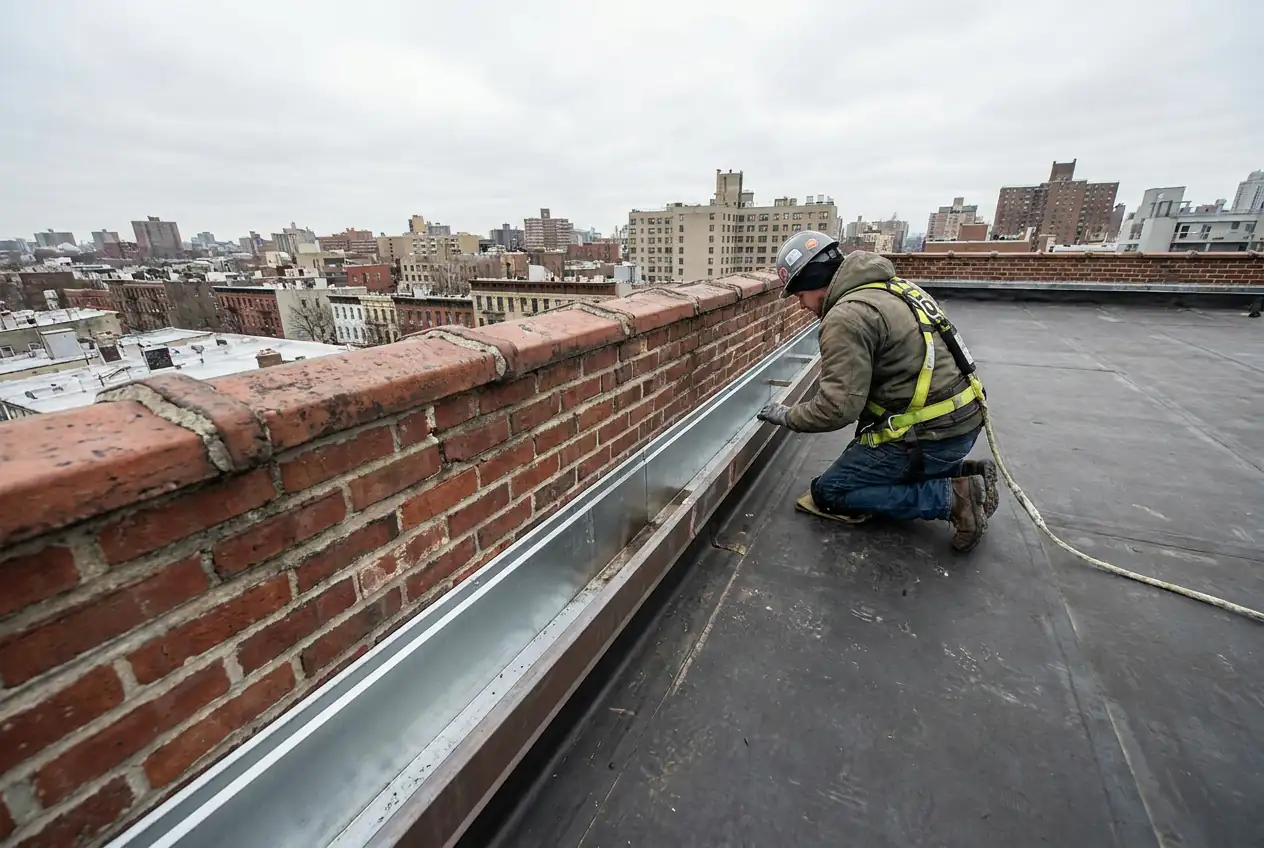
A box gutter does not hang off the roof edge. It is built into the roof itself: a timber trough lined with metal or membrane, running behind a parapet wall or tucked between two roof slopes. Nearly every American home put up before 1950 with a flat front, and plenty of flat-roofed additions since, drains through one.
That hidden position is the whole problem. A hanging gutter fails in public, dripping where you can see it. A box gutter fails inward. The trough floor rusts through or a joint opens, and the water takes the shortest path into the house: along a beam, down a wall cavity, out through a ceiling ten feet from the actual hole.
By the time a stain appears, the leak has usually been running for seasons. This is why we open every job with a survey rather than a sales pitch. Someone has to stand in the trough, meter the timber and find out which of the six classic failures is at work before any fix is worth pricing.
The six ways a trough gives up
Every survey checks all six, photographs what it finds and writes down which ones your roof actually has.
Lining options, with their honest lifespans
The survey decides this, not the brochure. When a coat of liquid is the wrong answer we say so, and when it is the right one nobody will talk you into a rebuild.
Troughs we have stood in
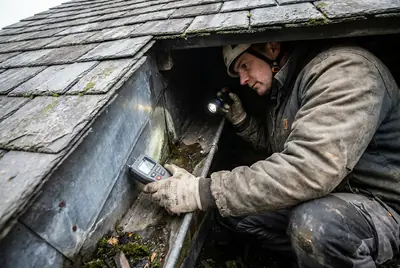
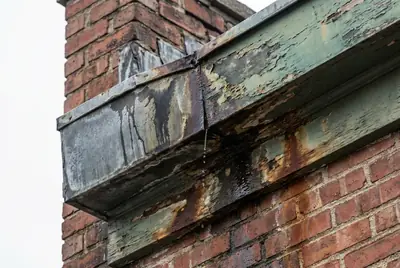
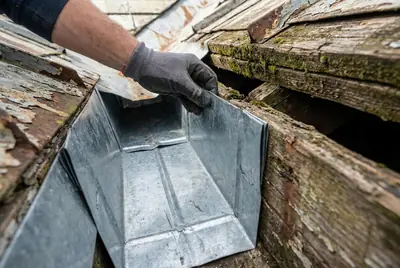
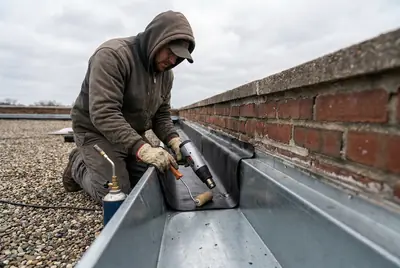
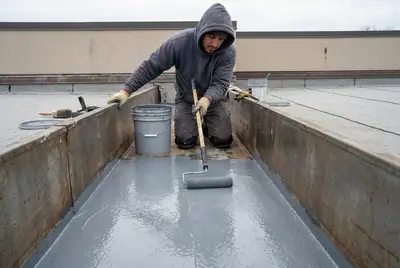
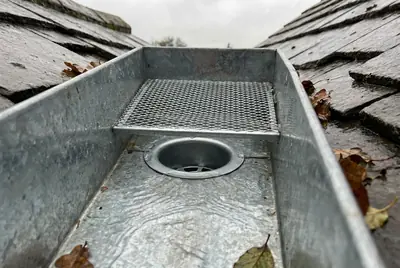
Homes that hide their gutters
Houses with history
Victorians, foursquares and rowhouses hide their gutters behind cornices and crown moldings, exactly where a ladder inspection never looks. The trough is often original, which means a century of patches over the first liner.
We work from the roof, keep the cornice profile intact and match liner details to the age of the house. The neighbors notice fresh paint, not our scaffold.
Flat roofs and additions
Parapet gutters on flat-roofed homes feed internal downpipes, so one blocked outlet can put water through every ceiling below. Porches and long additions add valley troughs that run well out of sight.
We schedule around family life, document every finding for you and your insurer, and can put the trough on a standing maintenance rota so the next blockage never becomes a claim.
Four moves, one dry house
- 1
Call the trough desk
One call to (844) 213-6324: ZIP code, what the gutter is doing and roughly when the home went up. Photos can wait for the survey, and the date is set before you hang up.
- 2
The roof survey
We walk the trough end to end, meter the timber, photograph every junction and lift what needs lifting.
- 3
The report and the quote
One document: what is failing, what can wait, and what each fix costs. You keep it whichever way you decide.
- 4
The repair or the reline
Liner in, outlets flowing, and a hose test before the ladder comes down for the last time.
The price of a dry trough
Length, access and how far the rot has traveled set the final number. The survey settles all three, and hearing the figure commits you to nothing.
Asked from under a stained ceiling
How do I know my house has a box gutter at all?
If the roof meets a parapet wall, if the front of the house is flat with no gutter visible from the sidewalk, or if two roof slopes meet over a wall, water is running through a built-in trough. Homes put up before 1950 nearly always drain this way.
Why is the stain ten feet from where you found the hole?
Because water is a traveler. It leaves the trough at the failure, follows a beam or a wall cavity, and only drops when it runs out of road. Chasing the stain instead of the source is how houses end up with three patches and the same leak.
Can you reline the gutter without touching the rest of the roof?
Usually, yes. The liner sits inside the trough and is independent of the slates, shingles or membrane around it. We tie the new liner into the existing covering at the edges, and the rest of the roof never knows we were there.
Metal or membrane, which liner should I want?
The honest answer is the one that fits your trough, not the one with the best margin. Sound timber and straight runs favor folded metal for its lifespan. Twisting runs, many outlets or a tight budget favor rubber or liquid. The report prices what fits.
How disruptive is the work for the household below?
Less than a leak is. Nearly everything happens at roof level behind edge protection. Life at home carries on, and for occupied houses we sequence noisy cutting outside the hours that hurt.
What if you find the gutter boards are rotten?
Then the report says so, with photographs, and prices the rebuild as its own line. Nobody discovers a doubled invoice halfway through the job. Rot found at survey stage is a plan; rot found mid-reline is an argument, and we prefer plans.
The rooflines around Mower County
Zoom in on the flat roofs and parapets; the link ledgers below name every community our surveyors reach from here.
Every town worth a survey in Mower County
- Box Gutter Repair in Ramsey, MN 26,225 on the census
- Box Gutter Repair in Austin, MN 25,006 on the census
- Box Gutter Repair in Le Roy, MN 1,083 on the census
- Box Gutter Repair in Grand Meadow, MN 1,065 on the census
- Box Gutter Repair in Adams, MN 774 on the census
- Box Gutter Repair in Brownsdale, MN 613 on the census
- Box Gutter Repair in Racine, MN 459 on the census
- Box Gutter Repair in Lyle, MN 454 on the census
- Box Gutter Repair in Rose Creek, MN 440 on the census
- Box Gutter Repair in Dexter, MN 308 on the census
- Box Gutter Repair in Lansing, MN 161 on the census
- Box Gutter Repair in Waltham, MN 132 on the census
- Box Gutter Repair in Mapleview, MN 124 on the census
- Box Gutter Repair in Elkton, MN 113 on the census
- Box Gutter Repair in Taopi, MN 44 on the census
- Box Gutter Repair in Sargeant, MN 40 on the census
Onward through Minnesota, county after county
- Box Gutter Repair in Aitkin County, MN
- Box Gutter Repair in Anoka County, MN
- Box Gutter Repair in Becker County, MN
- Box Gutter Repair in Beltrami County, MN
- Box Gutter Repair in Benton County, MN
- Box Gutter Repair in Big Stone County, MN
- Box Gutter Repair in Blue Earth County, MN
- Box Gutter Repair in Brown County, MN
- Box Gutter Repair in Carlton County, MN
- Box Gutter Repair in Carver County, MN
- Box Gutter Repair in Cass County, MN
- Box Gutter Repair in Chippewa County, MN
- Box Gutter Repair in Chisago County, MN
- Box Gutter Repair in Clay County, MN
- Box Gutter Repair in Clearwater County, MN
- Box Gutter Repair in Cook County, MN
- Box Gutter Repair in Cottonwood County, MN
- Box Gutter Repair in Crow Wing County, MN
- Box Gutter Repair in Dakota County, MN
- Box Gutter Repair in Dodge County, MN
- Box Gutter Repair in Douglas County, MN
- Box Gutter Repair in Faribault County, MN
- Box Gutter Repair in Fillmore County, MN
- Box Gutter Repair in Freeborn County, MN
- Box Gutter Repair in Goodhue County, MN
- Box Gutter Repair in Grant County, MN
- Box Gutter Repair in Hennepin County, MN
- Box Gutter Repair in Houston County, MN
- Box Gutter Repair in Hubbard County, MN
- Box Gutter Repair in Isanti County, MN
Somewhere above these streets a trough is quietly rusting.
Call (844) 213-6324