
Box Gutter Repair in Jefferson County, Montana (MT)
Across Jefferson County, we keep the box gutters of farmhouses, rowhouses and older homes doing their quiet job: survey first, then a liner or rebuild priced in writing.
The call costs nothing and commits you to nothing. Any call-out fee for the survey is named when the date is set, and the written report follows the survey.
Restoring your metal roof drainage system in Jefferson County
Dealing with a leaky internal trough at the edge of your roof requires quick action to prevent structural rot. You can stop water damage by securing a local pro who knows how to seal and reinforce these heavy-duty roof channels. Requesting a free quote helps you find someone who understands the specific needs of these built-in systems.
Why these roof channels need attention
These hidden troughs act as the primary defense against water pooling on your roof line. Because they sit inside the roof structure, any small crack or rust spot can send moisture directly into your framing. Proper maintenance ensures that your home stays dry throughout the rainy seasons common across the Montana landscape.
Fixing these metal troughs involves cleaning out debris and inspecting the seams for signs of fatigue. A skilled worker will check for loose fasteners and missing sealant that allow water to bypass the drainage path. That level of care stops moisture from seeping into your attic or exterior walls.
The process of fixing your drainage system
Repairing these integrated metal paths often involves applying a durable waterproof membrane to cover old gaps. This flexible material bridges tiny fractures that otherwise invite mold and decay into your rafters. You get a watertight seal that lasts through harsh weather and heavy snow loads.
Choosing a professional for this job means you benefit from someone who uses high-quality seam sealant to bond metal parts together. This product creates a permanent barrier that resists shifting as your home expands and contracts during temperature changes. The result is a smooth flow that directs rainwater away from your foundation.
Finding help in the area
Getting a solid result depends on finding a local expert who is licensed and carries proper insurance for your safety. Always look for a crew that knows the specific building codes for this region so your system works exactly as intended. Having a professional handle the heavy work saves you from climbing ladders while ensuring the job is done right.
Asking for a written estimate allows you to understand the full scope of the project before any work begins. A good provider will explain why they choose certain materials like rust-resistant flashing or specialized adhesives for your roof. This transparency gives you peace of mind and keeps your property in great shape for many years.
Taking the next step for your roof
Ensuring your roof remains solid is a smart way to maintain the value of your property. You should identify any signs of sagging or leaking early to avoid expensive structural repairs later. Addressing these problems now keeps your living space in a state of deep tranquility and keeps your wallet much fuller.
You can get started by describing your specific drainage issue to a local contractor. Requesting a free, no-obligation quote is the fastest way to get your questions answered by someone who knows these systems inside and out. Simply provide the details of your project to begin the process of protecting your roof today.
What a box gutter is, and why yours leaks
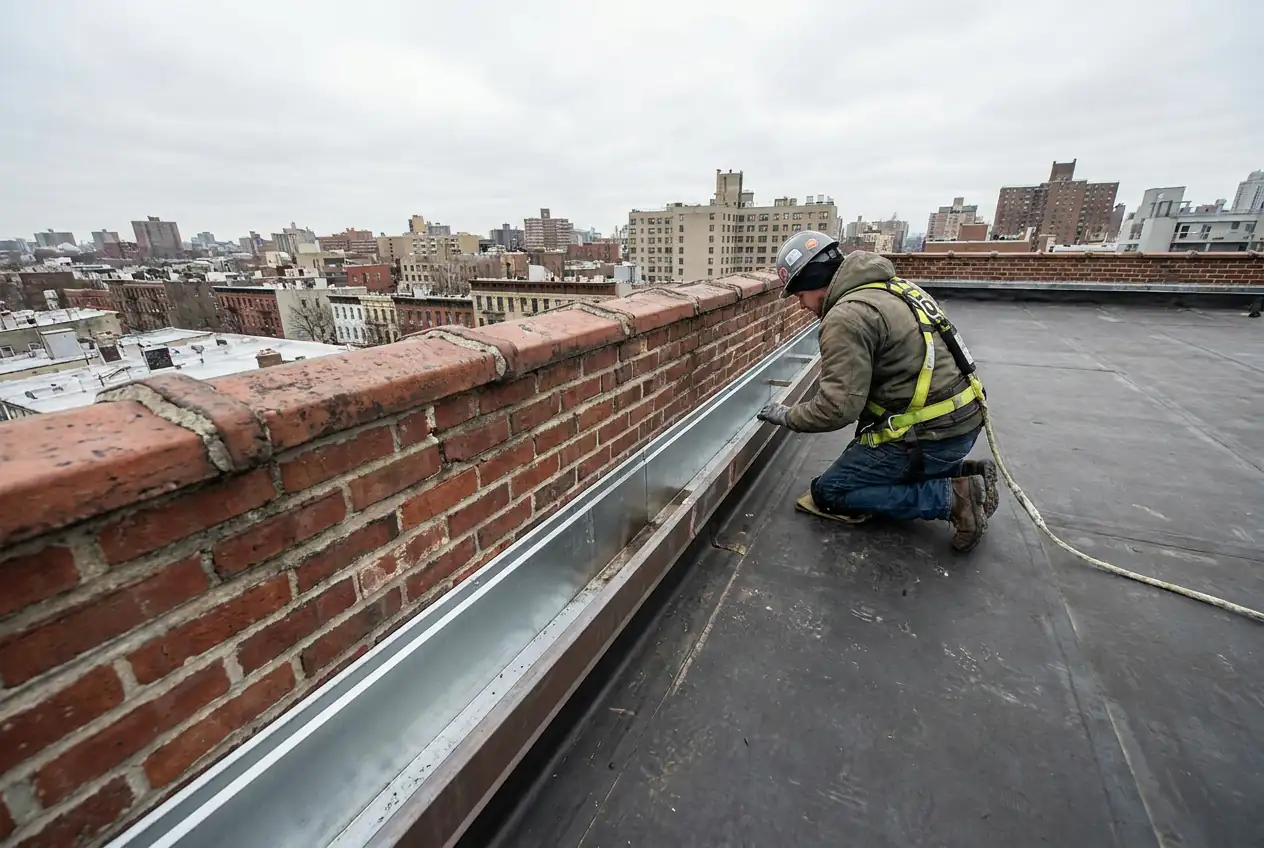
A box gutter does not hang off the roof edge. It is built into the roof itself: a timber trough lined with metal or membrane, running behind a parapet wall or tucked between two roof slopes. Nearly every American home put up before 1950 with a flat front, and plenty of flat-roofed additions since, drains through one.
That hidden position is the whole problem. A hanging gutter fails in public, dripping where you can see it. A box gutter fails inward. The trough floor rusts through or a joint opens, and the water takes the shortest path into the house: along a beam, down a wall cavity, out through a ceiling ten feet from the actual hole.
By the time a stain appears, the leak has usually been running for seasons. This is why we open every job with a survey rather than a sales pitch. Someone has to stand in the trough, meter the timber and find out which of the six classic failures is at work before any fix is worth pricing.
The six ways a trough gives up
Every survey checks all six, photographs what it finds and writes down which ones your roof actually has.
Lining options, with their honest lifespans
The survey decides this, not the brochure. When a coat of liquid is the wrong answer we say so, and when it is the right one nobody will talk you into a rebuild.
Troughs we have stood in
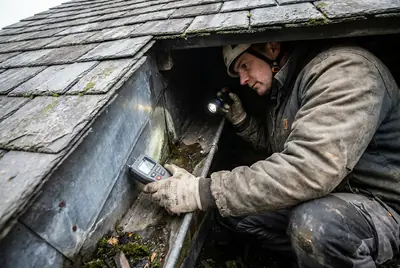
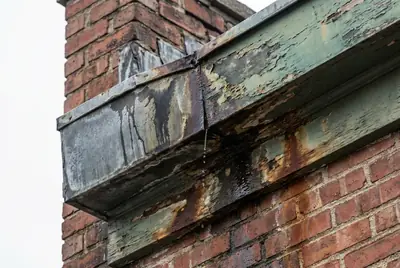
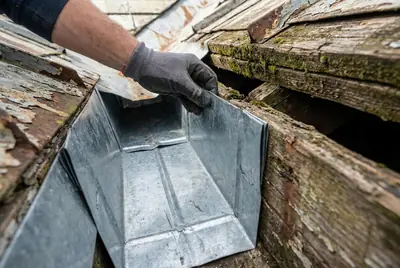
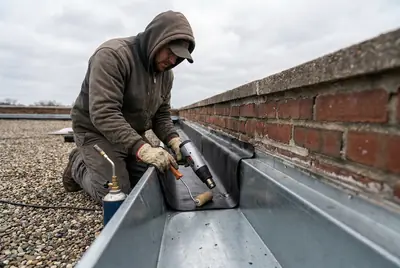
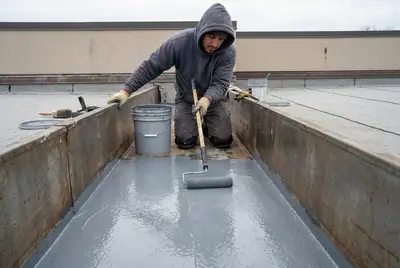
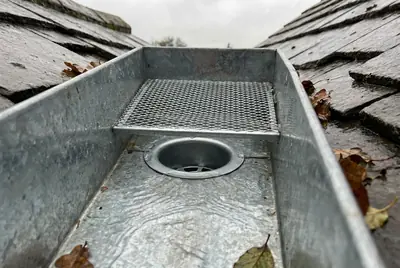
Homes that hide their gutters
Houses with history
Victorians, foursquares and rowhouses hide their gutters behind cornices and crown moldings, exactly where a ladder inspection never looks. The trough is often original, which means a century of patches over the first liner.
We work from the roof, keep the cornice profile intact and match liner details to the age of the house. The neighbors notice fresh paint, not our scaffold.
Flat roofs and additions
Parapet gutters on flat-roofed homes feed internal downpipes, so one blocked outlet can put water through every ceiling below. Porches and long additions add valley troughs that run well out of sight.
We schedule around family life, document every finding for you and your insurer, and can put the trough on a standing maintenance rota so the next blockage never becomes a claim.
Four moves, one dry house
- 1
Call the trough desk
One call to (844) 213-6324: ZIP code, what the gutter is doing and roughly when the home went up. Photos can wait for the survey, and the date is set before you hang up.
- 2
The roof survey
We walk the trough end to end, meter the timber, photograph every junction and lift what needs lifting.
- 3
The report and the quote
One document: what is failing, what can wait, and what each fix costs. You keep it whichever way you decide.
- 4
The repair or the reline
Liner in, outlets flowing, and a hose test before the ladder comes down for the last time.
The price of a dry trough
Length, access and how far the rot has traveled set the final number. The survey settles all three, and hearing the figure commits you to nothing.
Asked from under a stained ceiling
How do I know my house has a box gutter at all?
If the roof meets a parapet wall, if the front of the house is flat with no gutter visible from the sidewalk, or if two roof slopes meet over a wall, water is running through a built-in trough. Homes put up before 1950 nearly always drain this way.
Why is the stain ten feet from where you found the hole?
Because water is a traveler. It leaves the trough at the failure, follows a beam or a wall cavity, and only drops when it runs out of road. Chasing the stain instead of the source is how houses end up with three patches and the same leak.
Can you reline the gutter without touching the rest of the roof?
Usually, yes. The liner sits inside the trough and is independent of the slates, shingles or membrane around it. We tie the new liner into the existing covering at the edges, and the rest of the roof never knows we were there.
Metal or membrane, which liner should I want?
The honest answer is the one that fits your trough, not the one with the best margin. Sound timber and straight runs favor folded metal for its lifespan. Twisting runs, many outlets or a tight budget favor rubber or liquid. The report prices what fits.
How disruptive is the work for the household below?
Less than a leak is. Nearly everything happens at roof level behind edge protection. Life at home carries on, and for occupied houses we sequence noisy cutting outside the hours that hurt.
What if you find the gutter boards are rotten?
Then the report says so, with photographs, and prices the rebuild as its own line. Nobody discovers a doubled invoice halfway through the job. Rot found at survey stage is a plan; rot found mid-reline is an argument, and we prefer plans.
The rooflines around Jefferson County
Zoom in on the flat roofs and parapets; the link ledgers below name every community our surveyors reach from here.
Every town worth a survey in Jefferson County
- Box Gutter Repair in Montana City, MT 271,530 on the census
- Box Gutter Repair in Clancy, MT 1,986 on the census
- Box Gutter Repair in Boulder, MT 942 on the census
- Box Gutter Repair in Whitehall, MT 881 on the census
- Box Gutter Repair in South Hills, MT 700 on the census
- Box Gutter Repair in Jefferson City, MT 295 on the census
- Box Gutter Repair in Basin, MT 237 on the census
- Box Gutter Repair in Cardwell, MT 96 on the census
- Box Gutter Repair in Elkhorn, MT 10 on the census
Onward through Montana, county after county
- Box Gutter Repair in Beaverhead County, MT
- Box Gutter Repair in Big Horn County, MT
- Box Gutter Repair in Blaine County, MT
- Box Gutter Repair in Broadwater County, MT
- Box Gutter Repair in Carbon County, MT
- Box Gutter Repair in Carter County, MT
- Box Gutter Repair in Cascade County, MT
- Box Gutter Repair in Chouteau County, MT
- Box Gutter Repair in Custer County, MT
- Box Gutter Repair in Daniels County, MT
- Box Gutter Repair in Dawson County, MT
- Box Gutter Repair in Deer Lodge County, MT
- Box Gutter Repair in Fallon County, MT
- Box Gutter Repair in Fergus County, MT
- Box Gutter Repair in Flathead County, MT
- Box Gutter Repair in Gallatin County, MT
- Box Gutter Repair in Garfield County, MT
- Box Gutter Repair in Glacier County, MT
- Box Gutter Repair in Golden Valley County, MT
- Box Gutter Repair in Granite County, MT
- Box Gutter Repair in Hill County, MT
- Box Gutter Repair in Judith Basin County, MT
- Box Gutter Repair in Lake County, MT
- Box Gutter Repair in Lewis and Clark County, MT
- Box Gutter Repair in Liberty County, MT
- Box Gutter Repair in Lincoln County, MT
- Box Gutter Repair in Madison County, MT
- Box Gutter Repair in McCone County, MT
- Box Gutter Repair in Meagher County, MT
- Box Gutter Repair in Mineral County, MT
Somewhere above these streets a trough is quietly rusting.
Call (844) 213-6324